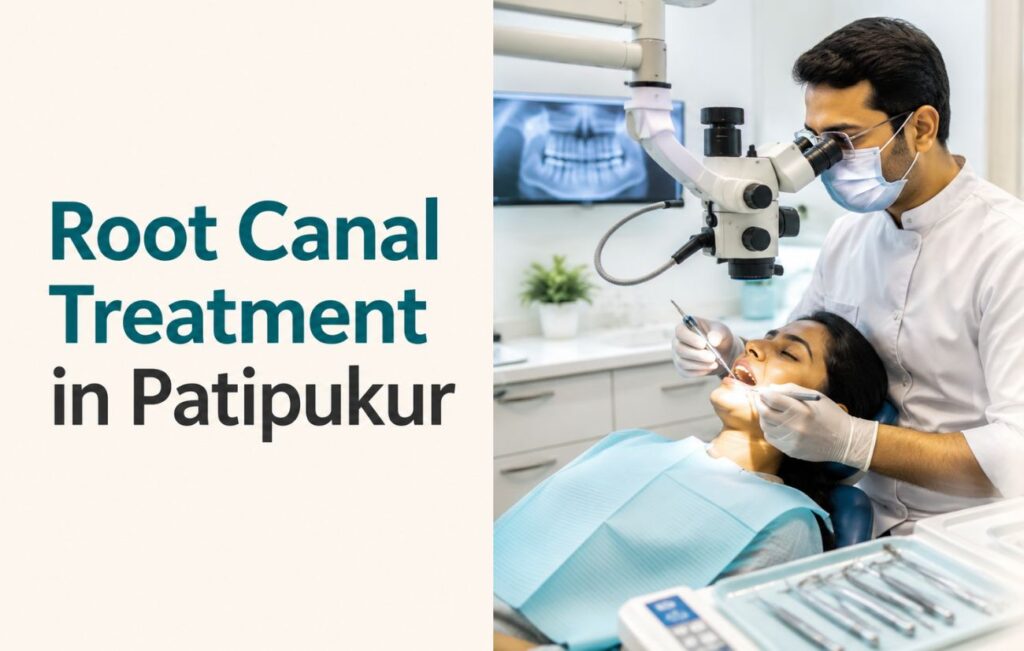
Root canal treatment saves a tooth that has become infected or badly damaged. With today’s equipment and local anaesthesia, the procedure is far less unpleasant than its reputation suggests. If you are considering root canal treatment in Patipukur, knowing what happens at each stage makes the decision much easier to take.
Plenty of people tense up the moment they hear the words “root canal”. The treatment is designed to relieve pain, not cause it. Your dentist removes the infection from inside the tooth and seals it, so the natural tooth stays where it is and keeps doing its job. No extraction needed.
What Is Root Canal Treatment?
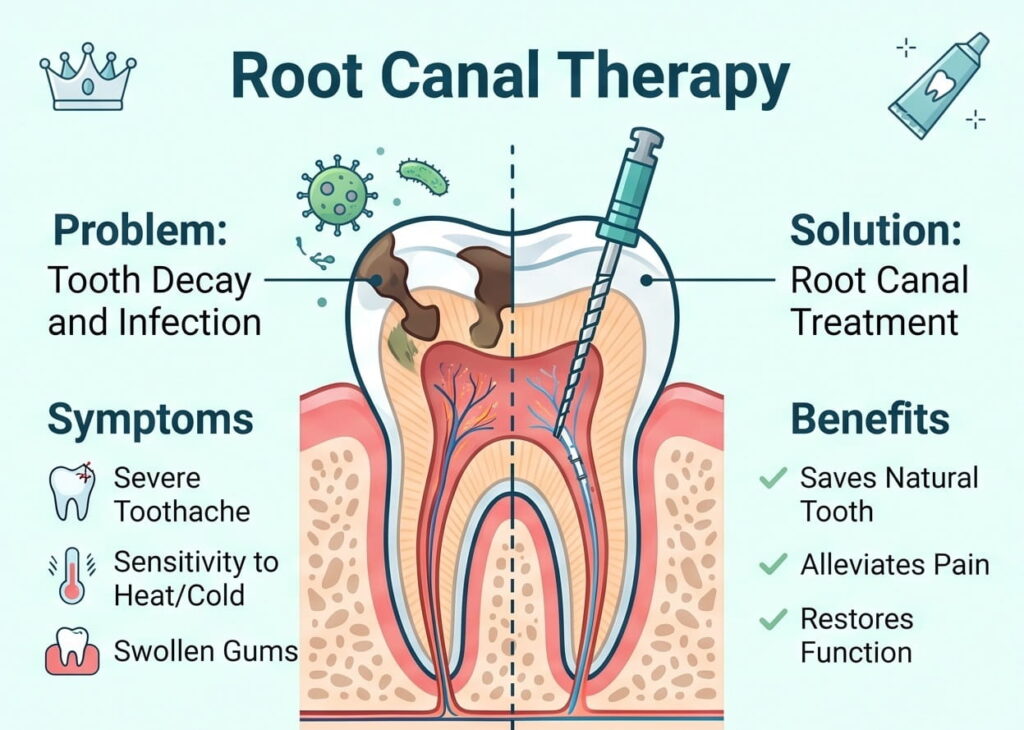
Root canal treatment, also called endodontic treatment, treats infection inside a tooth. Deep within every tooth is a soft tissue called the dental pulp, which holds the nerves and blood vessels. When bacteria reach it through deep decay, a crack, an injury or repeated dental work, the pulp becomes inflamed or infected.
During the procedure, the infected pulp is removed, the inside of the tooth is cleaned and disinfected, and the canals are sealed with a specialised filling material. A dental crown is often placed afterwards to strengthen and protect the treated tooth.
Saving the natural tooth is usually the better option. It keeps your chewing normal, keeps your bite intact, and stops neighbouring teeth from drifting into the gap.
When Do You Need Root Canal Treatment?
Not every toothache needs a root canal. But some symptoms do point to an infected pulp.
The most common warning signs:
- Toothache that keeps coming back and will not settle
- Sharp pain when you chew or bite
- Sensitivity to hot or cold that lingers after the food is gone
- Swollen or tender gums near a tooth
- A tooth that has started to darken
- A pimple-like swelling on the gum, sometimes releasing pus
An infected tooth can also be surprisingly quiet in the early stages, which is one reason routine dental check-ups matter. Your dentist can spot the problem before it announces itself.
If any of these sound familiar, get it looked at soon. The longer an infection sits, the further it spreads and the more complicated the treatment becomes.
What Happens During a Root Canal Procedure?
For most first-time patients, the worst part is not knowing what is coming. So here is the sequence.
It starts with an examination. Your dentist checks your symptoms, looks at the tooth and usually takes digital X-rays to see how far the infection has travelled and what condition the surrounding bone is in.
Once root canal treatment is agreed, local anaesthesia is given to numb the area completely. With modern anaesthetic, most patients feel nothing sharp through the procedure.
A small opening is made in the tooth to reach the infected pulp. Using fine instruments, the dentist removes the damaged tissue and cleans the narrow root canals. The canals are disinfected to clear out the bacteria, then filled and sealed so reinfection cannot take hold.
Depending on the tooth, this may be done in one appointment or across two visits. If a lot of tooth structure has been lost, your dentist will usually recommend a dental crown to restore its strength.
Does Root Canal Treatment Hurt?
The biggest myth about root canal treatment is that it is agony. Modern dentistry has moved on.
Most people say it feels much like having a routine filling done. The local anaesthetic numbs the area properly and the dentist works comfortably.
The toothache from an infected pulp is usually far worse than the treatment. Root canal therapy removes the source of that pain, which is why so many patients walk out feeling better than when they walked in.
Mild tenderness or sensitivity for a few days afterwards is normal, and it settles with the medication your dentist recommends.
How Long Does Root Canal Treatment Take?
It depends on where the tooth sits, how many canals it has, and how bad the infection is.
Straightforward cases are often finished in one appointment. More complex teeth, molars in particular, tend to have several canals and may need two visits.
Your dentist will talk you through the plan after examining the tooth and reading your X-rays.
What Should You Expect After Treatment?
For a day or two you may notice mild discomfort while chewing. That is the tissue around the tooth healing, and it passes.
Your dentist may ask you to avoid hard food on the treated side until the tooth has been permanently restored. Keep up your oral hygiene through the healing period: brush twice daily and clean between your teeth as advised.
If you get severe pain, swelling that grows, or discomfort that is not improving, call your dentist.
How to Care for Your Tooth After Root Canal Treatment?
Aftercare decides how long the treatment lasts.
Brush twice a day with fluoride toothpaste and keep flossing or using interdental brushes. Turn up for your follow-up appointments so your dentist can check the healing and finish the permanent restoration.
If a dental crown has been recommended, do not put it off. A crown strengthens the treated tooth and cuts the risk of it fracturing, and that matters most for back teeth, which take the heaviest chewing load.
A dental check-up every six months catches new problems while they are still small.
Why Choosing an Experienced Dental Clinic Matters?
The success of a root canal depends on the diagnosis and the planning as much as the procedure itself.
An experienced team examines the tooth properly with modern diagnostic technology before starting. Better equipment cleans the canals more thoroughly, and thorough cleaning is what makes the result last.
Comfort counts too. A dentist who takes dental anxiety seriously will explain each stage, answer your questions and make sure you are not lying there guessing.
A clinic you trust will also give you aftercare advice that fits your mouth rather than a leaflet, so your natural teeth stay with you longer.
Why Patients Near Patipukur Trust Arogyam Dental Clinic?
If you are looking for root canal treatment near Patipukur, Arogyam Dental Clinic offers dental care built around patient comfort. The clinic is in Paikpara, a short trip away, and provides painless root canal treatment alongside preventive, restorative, cosmetic, orthodontic and implant dentistry.
The dental team explains every stage of treatment before it begins, so patients know exactly what is happening and why. Each treatment plan is built around the individual’s dental needs, from diagnosis through to recovery.
Patients from Patipukur, Milk Colony, Dutta Bagan, Tala, Belgachia, Paikpara, Dum Dum, Cossipore, Shyambazar and nearby North Kolkata come to Arogyam Dental Clinic for its modern technology and patient-friendly approach.
If you have persistent tooth pain or suspect a tooth infection, early treatment can often save the natural tooth and spare you a more complicated problem later.
Conclusion
Ignore a persistent toothache and the infection worsens. Left long enough, it can cost you the tooth. Root canal treatment removes the infection, ends the pain and keeps your natural tooth in place. Knowing what happens before, during and after the procedure makes it much easier to go through with it.
At Arogyam Dental Clinic, we focus on comfortable, patient-centred dental care using modern techniques and advanced technology. Our team offers painless root canal treatment along with a full range of dental services, including dental implants, orthodontics, cosmetic dentistry and preventive care. Located in Paikpara, we see patients from Patipukur, Milk Colony, Dutta Bagan, Tala, Belgachia, Dum Dum, Cossipore, Shyambazar and nearby areas of North Kolkata. If you are in pain or think a tooth may be infected, book a consultation early. It is usually the difference between saving the tooth and losing it.
FAQs
1) Is root canal treatment painful?
No. Modern root canal treatment is done under local anaesthesia, so it is comfortable for most patients. Any mild soreness afterwards settles within a few days.
2) How many visits are required for root canal treatment?
Many teeth can be treated in a single visit. More complex cases may need two appointments. Your dentist will advise after examining the tooth.
3) Can I eat after a root canal?
Yes. Wait until the numbness has worn off, and avoid hard food on the treated tooth until your dentist confirms it is fully restored.
4) Will I need a dental crown after root canal treatment?
Often yes, particularly for molars and premolars. A crown strengthens the treated tooth, restores normal function and reduces the risk of fracture.